
Broken forever
War severed my late father's family in Ukraine more than 80 years ago. So many in his homeland now share the same pain.

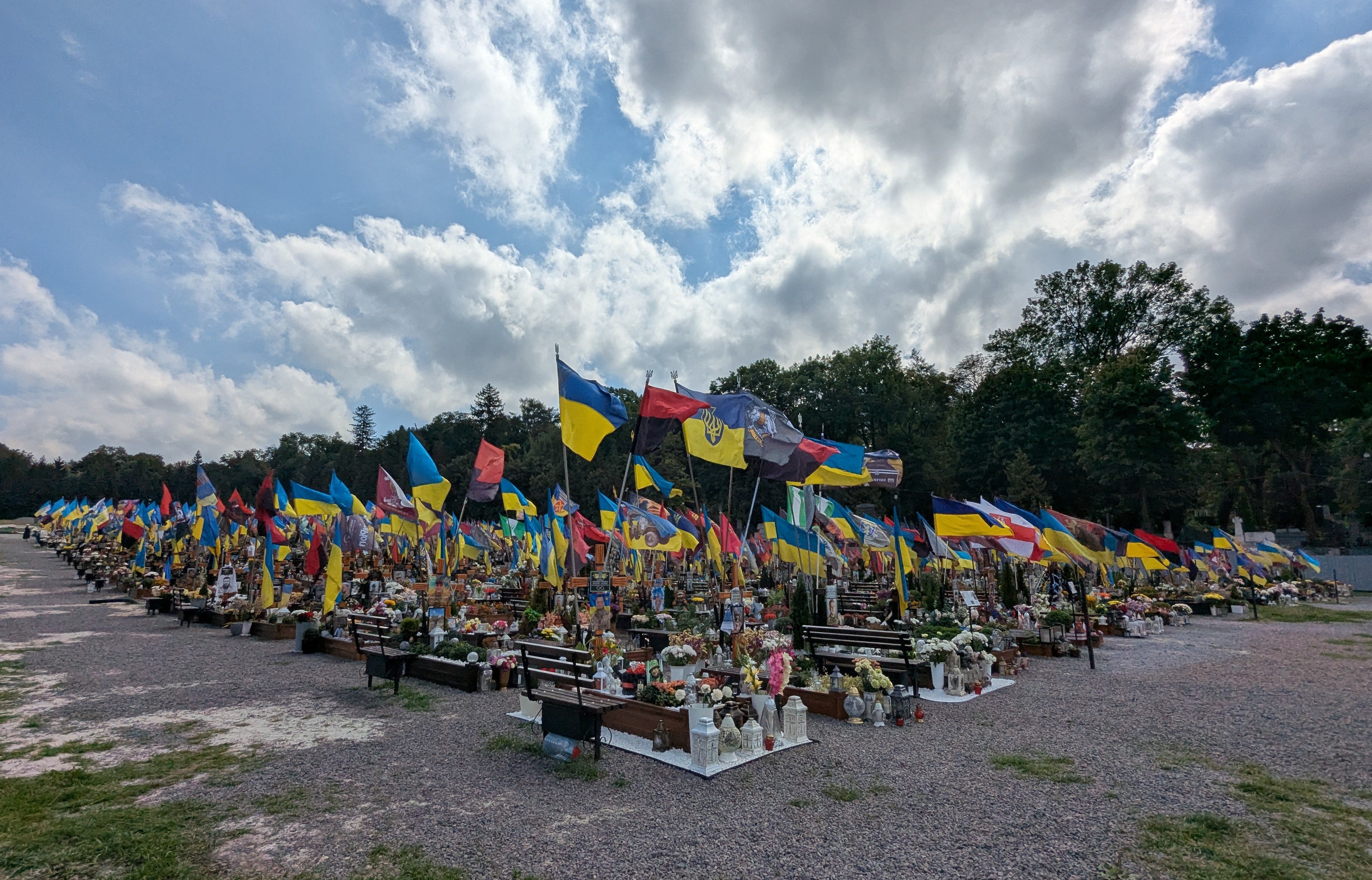
The Field of Mars at Lychakiv Cemetery in Lviv is shown on Sept. 10, 2025. The expanse holds the graves of fallen soldiers from the Lviv region killed during Russia’s invasion of Ukraine. (c. Martin Kuz)
My father lies buried at the top of a rise in a cemetery a mile from the home where I grew up in Minnesota. The spot faces the house to the west and offers a vista of the Minneapolis skyline to the north. He picked out that plot more than a decade before he died in 2015 because, as he liked to say, “I want a view.”
On past reporting trips to Ukraine, I have visited the family grave of his parents and two of his brothers in the western city of Lviv. This morning, walking to their plot in Lychakiv Cemetery, I made a connection that previously escaped me — they, too, lie buried at the top of a rise. The thought hit me as I paused to catch my breath halfway up a longer, steeper hill than the one in the cemetery in Minnesota: I guess wanting a view runs in the family.
The occasion went beyond a desire to pay my respects to the parents and siblings he never saw again after World War II, the grandparents and uncles I never met. My father, Eugene Kuz, a Lviv native born on Sept. 10, 1923, would have turned 102 today.
He sought to liberate Ukraine as a member of the Galicia Division, and while he survived the war and remade his life in America, he lost his beloved homeland. The unit in which he served as a field medic fought against the Red Army, and he understood that as long as the Soviet Union existed, setting foot in Ukraine amounted to a death sentence. Later, after the Iron Curtain collapsed, poor health stole any chance for him to visit.
So I decided to gather with his family at their grave to celebrate his birthday and honor his memory. Or most of his family, I should say. Like Eugene, another of his brothers never returned; he was killed in action and buried in Austria in the waning days of WWII.
After hand-pruning the weeds in the center of the plot, I planted a small Ukrainian flag and a bouquet of blue and yellow flowers. Then I pulled a thermos of coffee from my backpack, poured a cup and started talking out loud. For the next hour, beneath a bright blue sky and standing alone in that area of the cemetery, I told the faded names on the headstone about the man I called Dad.
I thanked his parents, Vasyl and Anna, for bringing Eugene into the world. I assured them and his brothers, Vasyl and Volodymyr, that he always yearned to come home. And I lamented that the serrated blade of war has cut deep into Ukraine once again, cleaving lives and families apart.
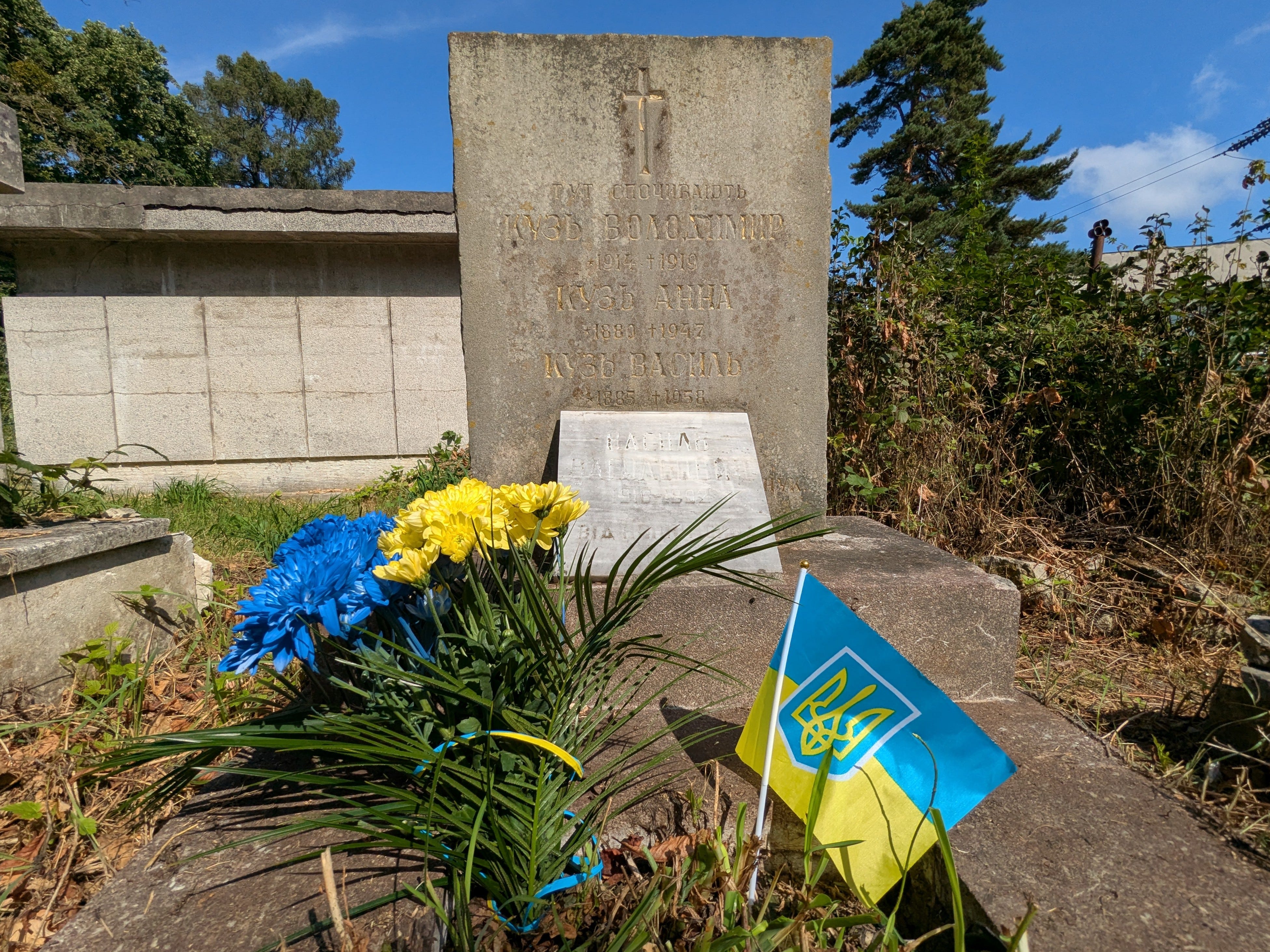
My late father’s family grave in Lychakiv Cemetery in Lviv, where his parents and two of his brothers are buried. (c. Martin Kuz)
The men and women buried across Lychakiv’s rolling, forested grounds include thousands of civilians and thousands more soldiers from armed conflicts dating to the early 19th century. The arrival of a new generation of war dead — the sons and daughters of the Lviv region — prompted the city to designate a section outside the cemetery’s walls as a burial site for victims of Russia’s invasion.
Each time I travel to Lviv, I return to the sloped expanse, known as the Field of Mars, to gain a sense of the war’s toll. In July 2022, the fifth month of the full-scale invasion, I counted 78 graves. The figure had climbed above 700 by last summer.
This afternoon, after saying farewell to my father’s family, I walked over to the field and gazed up the hill. I had braced myself for the moment yet still felt stunned, sickened, appalled. Furious. The number of graves appears to have doubled — at least — since a year ago.
A burial ceremony for three fallen soldiers had ended some time earlier. Their loved ones moved in silence down the hill toward the parking lot. Some wiped away tears. Now as 80 years ago, when war descended on Vasyl and Anna Kuz and their sons, so many families across Lviv and Ukraine know that pain. So many families know they have been broken forever.
Etc.
— My sincere thanks for reading. Please share Reporting on Ukraine with anyone you know with an interest in the country and its people, and if you’re a free subscriber and find the newsletter worth your time, I hope you’ll consider upgrading to paid. My work is entirely self-funded, and it is paid subscribers who make my reporting trips possible. You can also support my work here. Thank you.
So sorry you had to send a message to your father about the devastating war on his birthday. Putin doesn’t have any humanity and shouldn’t be a part of our world 💙
Your dad's parents and brothers had been waiting a long time for your update, and they are getting to know you, too, in your visits. I hope I can do the same someday with my parents' families. Happy birthday to Dr. Kuz, a great man I wish I could have met.