
Sowing generational fury
Putin learned the hard way that his war, rather than turn Ukrainians against Kyiv, seeded lasting hatred for Russia. Netanyahu and Trump missed the memo.

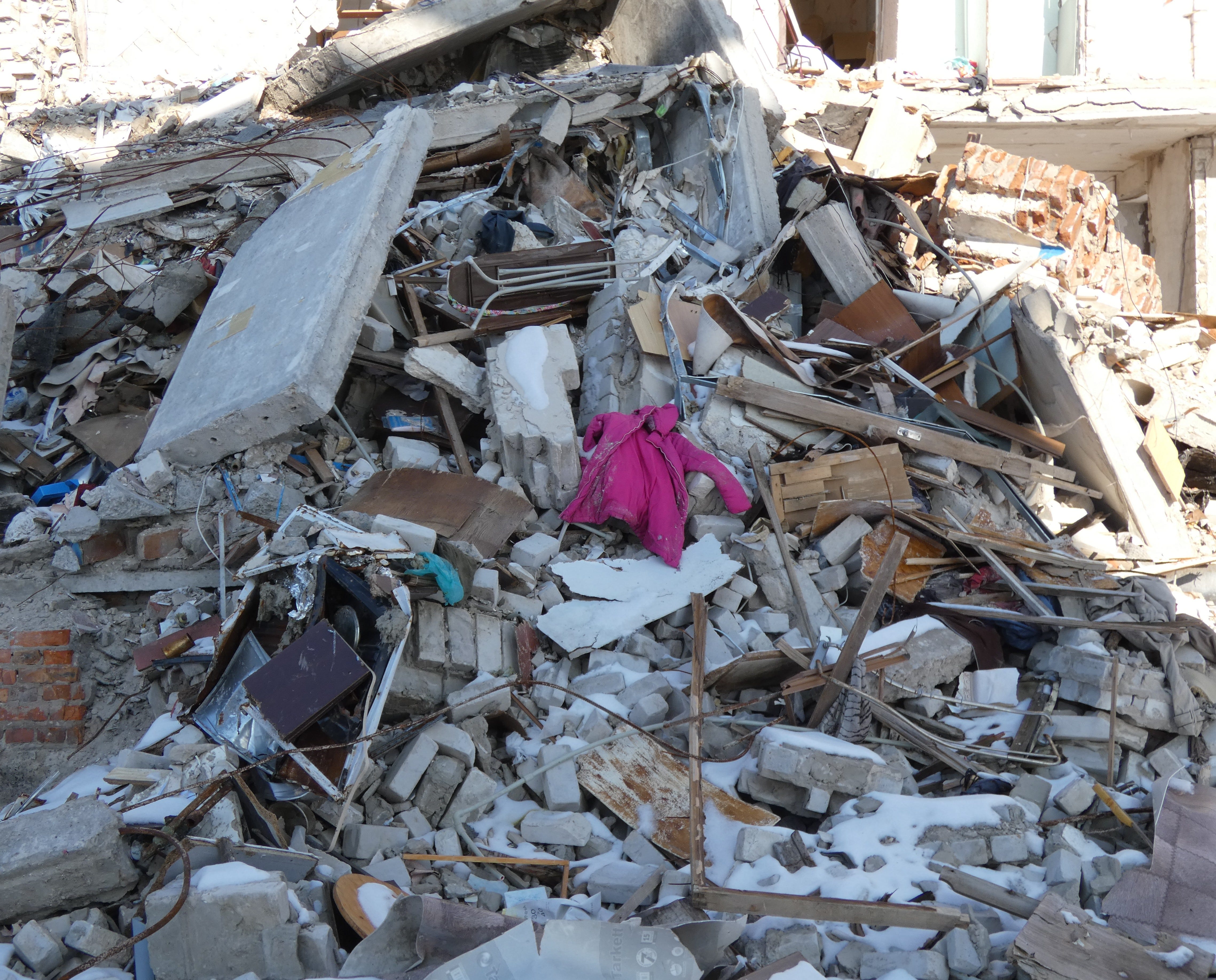
A jacket lies in the rubble of a destroyed apartment building in the eastern city of Izium, which Ukrainian troops freed from Russian occupation in fall 2022. (c. Martin Kuz)
Victoria Redko brought a homemade meal to her mother almost every Wednesday afternoon for a quarter-century. She prepared containers of favorite Ukrainian foods — borsch, dumplings, potato pancakes — before walking the mile to the house where she grew up and Olena Shevchenko still lived.
After Russian forces invaded Ukraine in February 2022, missile and artillery fire pounded Izium, a city in the eastern region of Kharkiv with a prewar population of 45,000. The fighting deterred Victoria from risking the trek to her mother’s house, and with the area’s electricity and cell service down, they managed only sporadic contact through March.
Izium fell to the Russians in early April. Worried about Olena, a pensioner and widow, Victoria decided to resume their lunch dates on the month’s first Wednesday even as intermittent shelling persisted. She filled two tote bags with food and set out for her mother’s house.
She never showed up. Over the next few days, Olena and her younger daughter, Natalia, who lived elsewhere in Izium, waited in vain for news. Thousands of residents had fled, and with the arrival of the Russians, fear and disorder reigned.
Natalia finally learned the worst from a neighbor of her sister’s. An artillery blast killed Victoria, 52, as she walked to her childhood home. The Russians had buried her in a mass gravesite at the north edge of town.
Soon after I met Olena the following winter, her grief broke the surface. “I feel totally destroyed,” she said. We sat in the kitchen where she and her eldest daughter had shared so many conversations. An artificial rose stood in a vase on the dining table in memory of Victoria, who left behind two adult sons. Olena wiped away tears. “I have a sadness that is deeper than anything I have ever felt.”
A child of the Soviet Union, Olena, 76, spoke in Russian, the dominant language of eastern Ukraine, where her family has lived for generations. Before the war, the region’s kinship with the country next door existed as a matter of course, a bond rooted in religion, culture and history. Two of her uncles served in the Red Army during World War II as the USSR fought to free Ukraine from German occupation. Her father told stories of Soviet soldiers handing out bread, clothing and other provisions to suffering families.
Some 80 years later, Olena’s youngest grandchild — one of Victoria’s sons — enlisted in the Ukrainian army to fight the Russians. In fall 2022, his unit took part in a counteroffensive that liberated most of the Kharkiv region, and Ukrainian soldiers later discovered the gravesite in Izium that held 450 bodies, including his mother’s.
“In Soviet times, we thought Russia was against fascism. Now Russians are the fascists,” Olena told me. “We will always remember this aggression. I do not believe Russians understand that they cannot be forgiven.”


Olena Shevchenko (left) cried while recalling her daughter, Victoria Redko, who was killed by an artillery blast in the eastern city of Izium in April 2022. (Left: c. Martin Kuz; right: courtesy Olena Shevchenko)
Vladimir Putin launched his war of choice under the hallucination that Ukrainians would cheer the Russian dictator’s troops as “liberators” and aid them in seizing Kyiv. Four years later, displaying a similarly distorted sense of reality, Benjamin Netanyahu and Donald Trump started their own unjustified war as they urged Iranians to “take back their country.”
“Now, of course, it’s up to the people of Iran in the final count to change the government,” Netanyahu said last week, three days after Israel and America began bombing them. “But we are… creating the conditions for them to do so.”
Plenty of doubt persists about whether the Israeli leader and his U.S. counterpart ever believed such rhetoric — unlike Putin, who appeared genuinely surprised that Ukrainians spurned his pipe dream of ousting their government. A far more plausible explanation is that Netanyahu exploited Trump’s strongman delusions to coax him into waging an illegal war that the Israeli prime minister has fantasized about for decades.
Netanyahu’s obsession with reducing Tehran to Gaza-like rubble under the guise of ending Iran’s nuclear program dates to the start of his political career in the late 1980s. In Trump’s second term, he has found a powerful stooge to abet him, a fellow far-right traveler who happens to command the world’s most potent military. As a bonus for Netanyahu, the American president, guided as always by belligerent ignorance, has promoted the mirage of regime change — an aspiration that Israeli officials, less than two weeks into the war, have privately dismissed as “wishful thinking.”
The Iranian government’s violent suppression of a popular uprising that began late last year killed as many as 30,000 people. The crackdown stoked appeals within Iran — and among diasporas in the United States and elsewhere — for Israel and America to attack the Ayatollah Ali Khamenei and his murderous regime. Early strikes succeeded in eliminating the supreme leader and other top officials while the broader aim of toppling the government remains as elusive as before the first missiles dropped.
In the meantime, the Israeli and U.S. militaries have killed more than 1,300 civilians in Iran and displaced another 3.2 million. (The bombing has further claimed the lives of over 700 civilians in Lebanon and forced 700,000 to flee their homes.) If such numbers represent Netanyahu’s idea of “creating the conditions” for regime change, I suspect that most Iranians desperate for the country’s liberation imagined something other than a different government killing them.
Few Ukrainians wanted Russia to invade in 2022. Most of those sympathetic to Putin lived in a swath of southeastern Ukraine that Russia seized during its initial incursion into the country in 2014, where the Kremlin created a parallel news universe. Moscow bans Ukrainian television and online media outlets in the occupied regions, filling the vacuum with unceasing Russian propaganda that pushes anti-Kyiv and anti-West narratives.
Still, much like Olena Shevchenko, a large segment of Ukrainians held benign views of Russia until Feb. 24, 2022. Putin learned the hard way that his war, rather than turn Ukrainians against Kyiv, sowed deep hatred for Moscow — a sentiment that, as Olena suggested, will last for generations.
Netanyahu and Trump missed the memo. The initial groundswell of support among Iranians for Israel’s and America’s intervention will continue to dissolve as the war kills ever more civilians, destroys homes, schools and mosques, damages heritage and cultural sites across the country and blackens the rain.
A majority of Iran’s people crave regime change. The Israeli and American leaders raised and then crushed hopes for that possibility, and by instead inflicting mass death and widespread devastation, they have ensured that Iranians, to quote Olena, “will always remember this aggression.”
And like Putin, Netanyahu and Trump will accept none of the blame. No wonder they all get along so well.
Etc.
— In response to rising energy and fuel prices wrought by the Israel-U.S. war on Iran, the Trump regime has lifted sanctions on Russian oil. The move will provide Putin with a windfall to power his war machine. Insert facepalm and angry swearing emojis here.
— Last month I wrote about the International Olympic Committee’s absurd decision to ban a Ukrainian skeleton racer for his “remembrance helmet.” The International Paralympic Committee appears to suffer from the same strain of moral relativism, harassing Ukrainian athletes while allowing Russian and Belarusian athletes to compete under the flags of their respective nations.
— My sincere thanks for reading. If you’re a free subscriber and find Reporting on Ukraine worth your time, please consider upgrading to paid. You can also support my coverage here. Thank you.