
War and faith
In Russia's invasion, I see the absence of the Almighty. But in Ukrainians, I find hope that man’s inhumanity to man need not be the epitaph of our species.

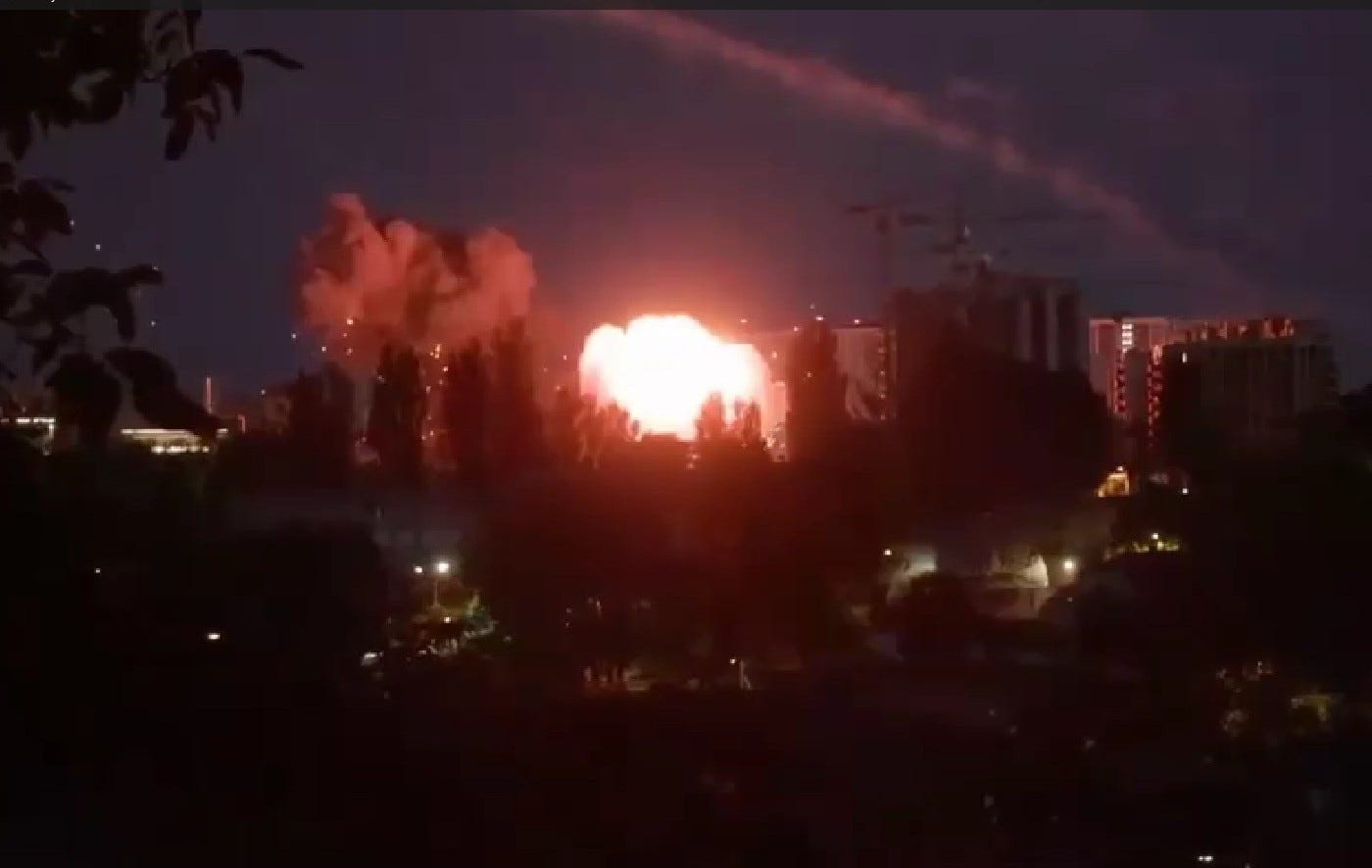
A video screenshot shows the impact of a Russian missile strike on an apartment building in Kyiv on June 2, part of a wide-scale attack across the capital and Ukraine that night. (Courtesy video provided by Ruslan Khmyz.)
The malign shadow of Russia has never lifted from the path of faith that Roman Khalus began following more than a decade ago as he prepared for the priesthood. In 2014, while he attended seminary in Lviv, a popular revolt in Kyiv ousted Ukraine’s then-president, Viktor Yanukovych, a thuggish errand boy for Vladimir Putin. The Russian dictator responded with force. Within two months, he annexed Crimea and dispatched troops in unmarked uniforms to seize a portion of Ukraine’s southeast, breaching the country’s sovereignty less than a quarter-century after the Soviet Union fell.
Moscow’s foray into the Donetsk and Luhansk regions displaced 1.6 million people. Some resettled in the northern city of Chernihiv, where Roman arrived in 2017 after his ordination to join the clergy of a Ukrainian Greek Catholic church. Their presence gave flesh to the distant abstraction of war that in February 2022 drew into sudden, terrifying focus for all of Ukraine.
At the outset of Putin’s full-scale invasion, 30,000 Russian troops advanced south from Belarus toward Chernihiv, an agricultural, industrial and tech hub of 280,000 residents. The ensuing siege killed over 700 civilians and damaged or destroyed an estimated 70 percent of the city’s buildings and homes. As half the population fled the Russian onslaught, heavy shelling crippled the power grid, depriving those who remained of heat, light and hot water in the dead of winter.
Roman’s church opened its doors to anyone in need. The space soon filled with mothers and children, pensioners and people with disabilities, and most stayed until the Ukrainian military drove out the Russians from Chernihiv five weeks later. Ministering to them as war demolished the order of life reinforced for Roman the purpose of his calling.
“As a priest, you can be near people, be next to them and give them emotional support,” he said. “No one is to be ignored, no one is to be denied God’s help.”
Since 2023, Roman, 36, has carried out his quiet mission to aid and comfort Ukrainians — to light a candle against the Russian darkness — at a Catholic church in Kovel. In my last newsletter, I wrote about the northwestern city of 70,000 people serving as a humanitarian way station for residents from the country’s occupied areas after they reenter Ukrainian-held territory. Russian authorities force Ukrainian citizens in those regions to endure a dayslong bus ride through Russia and then Belarus before allowing them to cross back into their homeland 45 miles north of Kovel.
Pensioners and mothers with young children account for the majority of travelers, and Roman’s church and another in the city offer them a place to eat, shower and sleep prior to resuming their journeys. When we met in the parish hall, I asked him a variation of a question he has heard countless times from refugees, congregants and soldiers alike: If a benevolent God exists, why does He permit so much cruelty, so much suffering?
His voice serene with conviction, Roman replied that the invasion, rather than disproving the Lord’s presence, reveals the need to live faith beyond thoughts and prayers. “We see that the Russians have evil intentions,” he said. “War is evidence that the spiritual fight is not just words. It’s physical.”


“The entire time, from seminary to now, I have been a wartime priest because of Russia,” said Roman Khalus, who serves at the Church of the Blessed Nicholas Charnetsky in the northwestern city of Kovel. (c. Martin Kuz)
I attended Catholic school through eighth grade and Mass for a few years longer even after realizing I had lost belief in theological fabulism, as I came to view Christianity and other denominations. A couple of nuns who applied the “strike the fear of God” aspect with excessive relish probably hastened my turning away, along with that whole creationism thing.
Still, an early immersion in matters of morality equalizes a young conscience, and for that alone I’m grateful for a religious upbringing. The experience could explain why, when reporting in war zones and areas beset by civil unrest, I seek out conversations with clergy members.
The primary reason for that relates to the breadth and depth of their ties to the community. More so than public officials, I’ve found, priests, pastors and their kind know the moods and sentiments of the people. The secondary reason pertains to my flailing attempts to understand “man’s inhumanity to man,” to quote the 18th century Scottish poet Robert Burns, and the inability of our supposedly enlightened species to evolve beyond conquest and bloodshed, oppression and tyranny.
Last week Russia unleashed another monstrous display of inhumanity with one of its largest drone and missile attacks of the war. The devastation in Kyiv and several more cities across Ukraine left 24 people dead and 150 wounded. Similar wide-scale strikes in the preceding weeks gutted apartment buildings and other civilian structures. As always, the barrages occurred overnight, a barbaric tactic intended to maximize casualties. Dozens more people lost their lives.
I checked in with relatives and friends after each bombing. Following a massive attack in May that flattened buildings in every district of Kyiv, I texted my friend Alla, who lives with her fiancé in Podilskyi. Homes, theaters, bookstores, cafes and a museum lay in ruins. “I am alive,” she wrote back, “but my neighborhood is destroyed.”
The United Nations reported last month that Russia has killed 16,000 Ukrainian civilians and wounded 45,000 during more than four years of war, adding that the true toll “is likely considerably higher.” Only Israel slaughters civilians — including infants — with greater frequency and in greater numbers than Russia.
Putin’s relentless massacring of ordinary Ukrainians and the world’s vigilant cowardice in response reaffirms for me the absence of anything resembling a higher authority. The brutishness of the tyrant abetted by the meekness of bystanders as a brave people bleed and bleed — this is our godless fate, our wretched earthbound reality. This is our existence without divine punishment for the malevolent and the indifferent, nor without deliverance for the innocent.
I asked Roman whether his framing of the invasion as an extreme test of individual faith reassures those who wonder why so much harm befalls their homeland. He allowed that, as with the towns and cities that Russia has pulverized, war can reduce belief to ashes.
“My explanation doesn’t bring peace (of mind) for everyone, especially among our military,” he said. “Everyone has their own experience, and there will be doubts for some.”
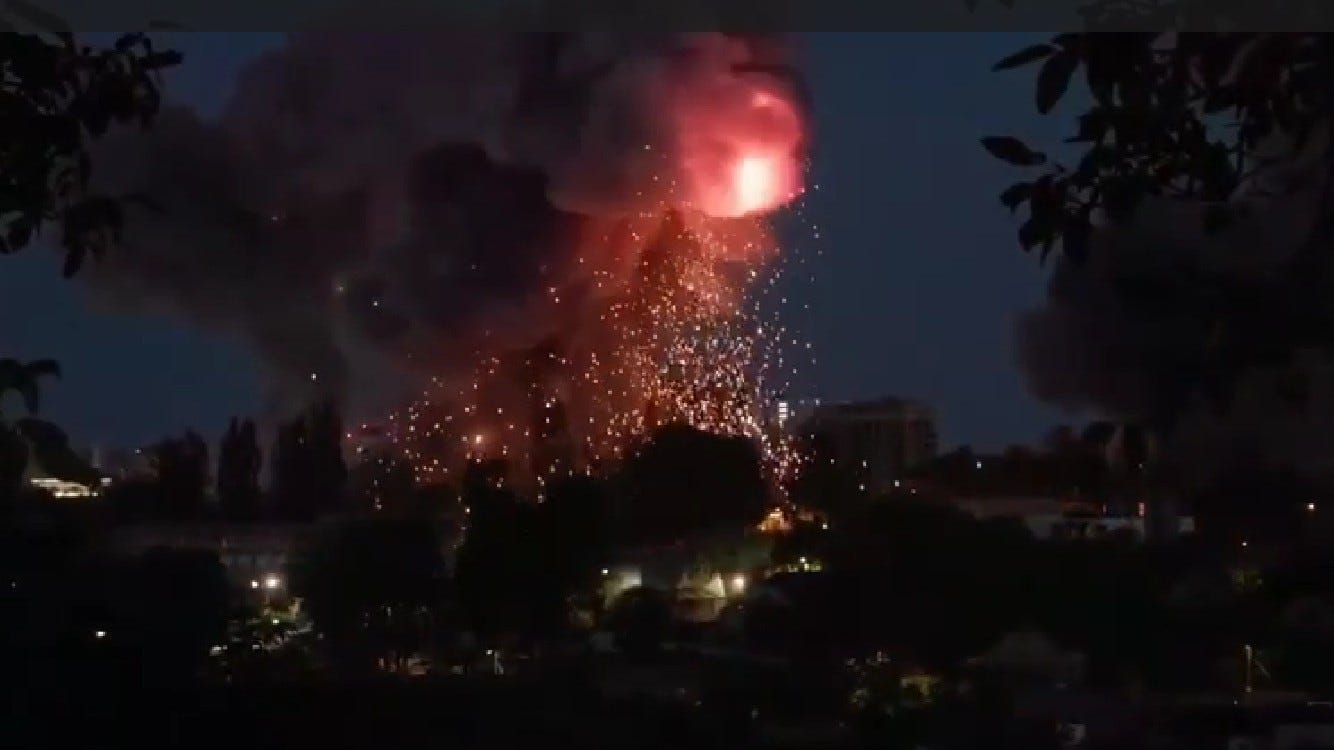
A video screenshot shows a fireball rising after another Russian missile strike on an apartment building in Kyiv on June 2. (Courtesy video provided by Ruslan Khmyz.)
Roman serves at the Church of the Blessed Nicholas Charnetsky, named for a Ukrainian bishop and beatified martyr. A person of faith might argue that the perseverance of Charnetsky and the Ukrainian Greek Catholic Church through decades of brutality under the Soviet Union attests to the power of spiritual conviction. In any case, the struggle for survival of both the man and his denomination mirrored Ukraine’s as a nation in the 20th century.
Born in 1884 in western Ukraine, Charnetsky arrived in Kovel in the 1920s as a missionary and worked to establish a church. Appointed bishop by Pope Pius XI in 1931, the same year as the church’s founding, he ministered throughout the Volhynia region, then part of Poland and now known as Volyn.
In 1939, on the eve of World War II, Germany and the Soviet Union signed the Molotov-Ribbentrop pact of nonaggression. Acting on the treaty’s secret terms, Adolf Hitler and Joseph Stalin began carving up large portions of Europe. Weeks later, the Red Army invaded a swath of eastern Poland that included Volhynia and the adjacent Lviv region, reclaiming land that the Poles seized from Ukraine in 1919, three years before the USSR formed and Moscow colonized Kyiv. (I know — it’s a little complicated.)
When Soviet troops occupied Volhynia and Lviv, Charnetsky and other clergy fled. Stalin wanted to eradicate religion and religious expression across the country — and the entire Soviet empire — as part of a wider campaign of terror to bury Ukraine’s culture, national identity and independence movement.
Starting in the late 1920s, he imposed a policy of “militant atheism” to crush the populist influence of churches, fearful that religious gatherings could foment peasant revolts against the regime. Soviet security forces executed, imprisoned or exiled tens of thousands of priests, monks and nuns. Thousands of churches were shut down, repurposed or destroyed.
The church in Kovel closed in 1939 and Charnetsky took refuge in a monastery in Lviv, where he stayed through the ensuing German occupation of the country from 1941 to 1944. Unlike the Soviets, the Nazis tolerated certain non-Judaic religions to varying degrees, and he joined the faculty of a reopened theological academy. He taught there until the Red Army reappeared in Lviv in summer 1944 as the Nazis retreated.
Moscow’s repression of religion and persecution of clergy intensified in Ukraine as the war wound down and for many years afterward, particularly in the west, the cradle of resistance to Russian rule. Stalin held deep animus for the Ukrainian Greek Catholic Church, then anchored in Lviv, for nurturing national pride and identity. By late 1944, as the Soviets reasserted full control over the country and the Red Army leveled Greek Catholic churches in Kovel and throughout the countryside, Stalin plotted to erase the denomination.
The next spring, a month before Germany surrendered, the Soviet secret police arrested several Greek Catholic leaders in the region, including Charnetsky, for refusing to abandon their church. He languished for most of the next 11 years in Siberian gulags, where his captors subjected him to hundreds of hours of interrogation and torture. In 1956, with his health in steep decline, prison officials released him to try to avoid blame for what they assumed would be his imminent death. He rallied to live another three years, returning to Lviv to carry on his mission.
Moscow relegated the Ukrainian Greek Catholic Church below the authority of the Russian Orthodox Church in 1946. Rather than accept subordination, Greek Catholic adherents and the church’s surviving clergy moved their worship underground.
Barred by authorities from fulfilling his pastoral duties, Charnetsky proved a pivotal figure in the catacomb church, as it was called, ministering in secret to visitors to his apartment. In similar fashion, he taught religion to students who came to see him and, in his most essential act, ordained more than a dozen young men for the priesthood, helping to ensure the church endured.
Charnetsky died in 1959 at age 74. Three decades later, Mikhail Gorbachev, the last Soviet president, eased religious restrictions and enacted sweeping economic and political reforms in a desperate effort to avert the empire’s collapse. Aided by Pope John Paul II, who went on to decree Charnetsky a modern martyr, the Ukrainian Greek Catholic Church regained legal status in 1989 and began resurfacing. The next year, Roman Khalus was born, and a year after that, the Soviet colossus succumbed, setting Ukraine free.


A memorial wall for Ukrainian soldiers from Kovel who have been killed since the Russian invasion began in 2014 stands in the city center. (c. Martin Kuz)
The Ukrainian Greek Catholic Church resumed holding services in Kovel in 2003 in a temporary wooden chapel, and the consecration of the permanent church took place in 2009. A person of faith might argue that the parish’s renewal testifies to God’s grace. In any case, its rebirth typifies the resilience of Ukrainians in the face of Russian belligerence, a recurring contagion in their country’s history.
Along with Hitler and Mao Zedong, Stalin embodied man’s inhumanity to man in the last century. Little has changed since then aside from the name of the Russian ruler inflicting the horrors and his feigned piousness.
Putin poses as a devout Christian, brandishing his Russian Orthodox faith with practiced cynicism to justify his “holy war.” Save for that performative religiosity, the latest Kremlin despot is Stalin 2.0, another vessel of genocide. In a revival of Soviet-era terrorism, his war has damaged or destroyed at least 740 religious sites in Ukraine; when combined with Russian occupation of Ukrainian territory, Putin has robbed millions of people of their houses of worship.
Even so, now as then, Moscow’s savagery has failed to diminish their faith in God. A national survey last year found that 70 percent of Ukrainians identified as “believers” irrespective of whether they attend church. The figure marks a 2.5 percent increase from 2021, a year before the full-scale invasion. A quarter of respondents reported that their faith deepened after the war started, compared with only 4 percent whose conviction receded. (An estimated 85 percent of Ukrainians who associate with a denomination identify as Christian.)
The numbers align with what I’ve observed from Kovel to Chernihiv, Lviv to Kharkiv, Kyiv to Odesa. I have met so many Ukrainians — civilians and soldiers — who live their spirituality with a reverent modesty that exemplifies the teachings of Jesus Christ.
Their faith is not the false, mouth-foaming, flag-swaddled, egocentric piety of the MAGA hordes, who exalt in Christofascism that grows from the poisoned soil of hate beneath a black sun of ignorance as personified by Pete “We Negotiate With Bombs” Hegseth. In Ukraine, regardless of daily prayer or weekly church habits, people show their faith moment to moment through collective, compassionate self-sacrifice. Putin appears unable to grasp — perhaps because of his own lack of selflessness, a deficiency he shares with Donald Trump — that Ukrainians hold an advantage on the battlefield and in civil society that Russians can neither match nor kill: belief in something greater than themselves, whether God, country or both.
The invasion has razed hundreds of villages, towns and cities in eastern and southern Ukraine and displaced almost 10 million people. Over one-third of them live elsewhere inside the country, with 4,000 residents from the occupied territories resettling in Kovel. Some attend the Church of the Blessed Nicholas Charnetsky, where Roman tries to offer them solace.
“The entire time, from seminary to now, I have been a wartime priest because of Russia,” he said. As we talked, he often smiled, possessed of a warmth and inner peace — an equilibrium — far more common among Ukrainians living under bombs than Americans waiting in drive-thru lanes. “What I believe is we can support one another through the spiritual life. This is an important part of faith — sharing it with others.”
A loving God, in my eyes, would relieve Ukraine’s suffering. A just God would smite Putin and prevent Russia from repeating again and again its history of conquest and bloodshed, oppression and tyranny. But as we live below a void above, I find hope here in Ukrainians, who give me faith that man’s inhumanity to man need not be our epitaph.
Etc.
— My apologies for the lengthy gap between newsletters. That’s why I made this edition extra long! More seriously, a couple of personal matters arose, including the loss of one of the most influential and truly wonderful people in my life. Tom Melchior, a former high school teacher of mine who became a mentor and friend, was a source of warmth and light and a staunch supporter of Ukraine. If you’ll indulge me, here’s my remembrance of him. (If you’re not on Facebook — first, bravo. Second, you still should be able to view the post by closing the pop-up box that appears.) He might remind you of one of your own teachers. How I miss him.
— Last month I had the good fortune to participate in a Zoom panel discussion on the evolution in independent journalism and why more writers are publishing on their own. I joined the estimable Liz Kelly Nelson and Michele Hornish, both of whom offered all kinds of useful tips. I highly recommend checking out the video of our conversation for their insights. Many thanks to moderator Patty Rasmussen and Katja Ridderbusch, president of the Georgia chapter of the Society of Professional Journalists, for organizing the event.
— My sincere thanks for reading. If you’re a free subscriber and find Reporting on Ukraine worth your time, I hope you’ll consider upgrading to paid. You can also support my self-funded coverage here. Thank you.
Oh Martin, what a hard/good post for this Christ follower to read. I can get in my bubble, see events through my faith lenses, and forget that not everyone reads them the same way. Your take is valid, raw, and real. You’ve talked to the people there and I have not. You are right to ask “Where is God?” I hope I would be honest enough to ask the same questions. As always, the deep reporting, the history and context about the people who laid the foundation, are relevant and appreciated. I am not only deeply challenged by what you have written—as a person of faith I wonder how I would answer your question—I am also far more informed about the nuance and history of the war in Ukraine.
Let’s face it: this isn’t just politics for Putin, it’s personal. And that’s ugly. That’s not a guy making moves on behalf of his country, this is a bully that wants to beat up the smaller kid because he doesn’t like them and because he thinks he can get away with it. And if the rest of the world lets him do that, the shame is on them/us as much as it is on him.
For whatever it is worth to you, God bless the good work you do, bringing light to the stories and bearing witness. You do your mentor’s memory proud. I am sorry for the loss of your friend. May his memory be a blessing. 🌿